
Science & Technology

World Growth Forums Magazine

Keynote Speech by Dr Alfredo Sfeir-Younis _ WGF-GBIF Thailand 2024
What Is Daylight Saving Time?
What Is the Science, the Safety, and the Global Clock Fight?
Across the United States and parts of Europe, millions of people ‘fell back’ an hour this weekend (U.S. on November 2, 2025; most of Europe/UK on October 26, 2025), marking the end of Daylight Saving Time (DST). For most, it meant an extra hour of sleep. For scientists, it marked another annual experiment in social jet lag.
Daylight Saving Time (DST) – the practice of shifting clocks twice a year – was once a symbol of efficiency and innovation. But a century later, it’s a subject of growing scrutiny.
Studies now link clock changes to higher risks of heart attacks, road accidents, and even depression. Yet debates over whether to end DST have stalled, leaving the world divided between the rhythm of the sun and the rhythm of the law.
From disrupted circadian rhythms and health concerns to political gridlock in Washington and Brussels, DST has become less about saving daylight and more about saving ourselves from its effects.
Image 1: Every clock change is a reminder of how societies still try to govern sunlight – even when the human body disagrees.
Click Here to Read WGF Blogs from World Leaders…
What Is the Story of Daylight Saving Time?
The idea of changing time with the seasons began as a wartime efficiency experiment. In 1916, Germany and the UK adopted Daylight Saving Time to conserve fuel and extend daylight during working hours. The United States followed in 1918, repealed it after public backlash, then reinstated it permanently in 1966 under the Uniform Time Act.
DST aimed to make better use of daylight – an extra hour for farmers, factories, and families. But its logic was born in a world lit by coal lamps, not 24-hour LED screens.
In the early years, countries saw minor energy savings, but complaints soon followed: darker mornings for schoolchildren, confusion in train schedules, and public frustration over disrupted sleep.
By the late 20th century, studies began linking spring-forward time changes to higher rates of heart attacks (4% rise), car crashes (6% increase), and short-term sleep deprivation.
Meanwhile, European research suggested autumn clock shifts might raise depressive episodes by 11%.
Governments tried to fix it. The U.S. experimented with year-round DST in 1974, but dark winter mornings proved unpopular. The EU voted in 2019 to end clock changes but has not agreed on whether to stay on summer or winter time.
The clock, quite literally, is stuck.
Click Here to Read What Is a Blood Moon…
Image 2: Born as a wartime energy measure, Daylight Saving Time has outlived the age of coal – but not the debate over its purpose.
Did You Know?
Daylight Saving Time
- About 70 countries observe DST – less than one-fourth of the world
- India, Japan, and China never adopted DST
- The European Union voted in 2019 to abolish clock changes, but implementation remains stalled
Did You Know?
Circadian Clock
- Your circadian rhythm regulates sleep, hormones, and alertness
- Even a one-hour shift can alter melatonin and cortisol levels
- Disrupted body clocks are linked to higher risks of depression and heart disease
Did You Know?
Permanent Standard Time
- Standard Time aligns with solar time, matching sunrise and sunset more naturally
- Sleep researchers argue Permanent Standard Time supports human health better than Permanent DST
- The S. tried year-round DST in 1974 – public protests reversed it within months
Did You Know?
Seasonal Affective Disorder
- SAD affects around 1 in 15 people in northern countries each winter
- Symptoms include low mood, fatigue, and sleep disruption due to less sunlight
- Light therapy lamps and outdoor routines can reduce symptoms significantly
Click Here to Read What Is NATO…
Daylight Saving Time In Numbers
• ~70: Around 70 countries worldwide still observe Daylight Saving Time in some form – fewer than one-fourth of countries globally
• +4%: Heart attack cases rise by about 4% in the week following the spring clock change, according to a major meta-analysis
• +6%: Fatal road accidents increase by roughly 6% in the days immediately after the spring shift, as sleep-deprived drivers face darker mornings
• +11%: Depressive episodes climb by nearly 11% in the ten weeks following the autumn clock change, based on long-term research from Denmark
• €750 ($880): Economists estimate the annual cost of clock changes at about €750 (or $880) per person, factoring in healthcare expenses, productivity loss, and reduced life satisfaction
Click Here to Watch Keynote Speeches and Interviews of World Leaders at WGF YouTube…
Historical Note
When Britain introduced Daylight Saving Time in 1916, one of its loudest advocates was builder William Willett – the great-great-grandfather of Coldplay’s frontman Chris Martin.
Willett was frustrated that people ‘slept through a large part of a summer day’. His pamphlet ‘The Waste of Daylight’ urged Parliament to move clocks forward by twenty minutes each week in April and reverse them in September. Though Willett died before his idea became law, the country eventually adopted his proposal during World War I – and his morning rides through Petts Wood inspired the movement that still divides the world today.
Click Here to Read What Is the Trump–Putin Alaska Summit About…
So, What Exactly Is Daylight Saving Time, and Who Observes It Today?
Daylight Saving Time (DST) is the practice of setting clocks one hour ahead in spring and one hour back in autumn to extend evening daylight.
Today, most of Europe, North America, and parts of the Middle East and Oceania observe DST, while Asia and Africa largely ignore it. The UK’s clock change occurs on the last Sunday of March and October. In the U.S., it happens on the second Sunday in March and the first Sunday in November.
Countries near the equator – where daylight remains almost constant – see no reason for the switch. India, for instance, runs on Indian Standard Time (IST) year-round, unaffected by global time politics.
Click Here to Watch WGF News on World Leaders at WGF TV…
What Is the Uniform Time Act of the U.S.?
Passed in 1966, the Uniform Time Act created national consistency. Before it, cities set clocks differently – a nightmare for transport and broadcasting. The Act established standardized start and end dates for DST across states, though it allowed states to opt out.
Arizona and Hawaii still operate without DST. The rest of the country ‘springs forward’ and ‘falls back’ under federal guidelines – unless Congress decides otherwise. The latest proposal, the Sunshine Protection Act, aims to make DST permanent, but it remains trapped in legislative limbo.
Click Here to Read What Is A Ceasefire Agreement…
What Are ‘Spring Forward’ and ‘Fall Back’?
The popular rhyme helps people remember the biannual ritual: Spring forward, fall back.
Every March, clocks move forward one hour – stealing an hour of sleep but extending evening light. Every October or November, clocks move back – returning that hour but making evenings darker.
While this seems harmless, studies show that even a one-hour change disrupts sleep patterns for days, affecting mood, productivity, and health.
Click Here to Read What Is De-Dollarisation…
What Does the Science Say About Health and Sleep?
Our bodies run on circadian rhythms. When the clock shifts, that alignment falters.
Scientists at Oxford and LSE note that even a one-hour misalignment can create a ripple effect of fatigue, hormonal imbalance, and stress. During spring’s forward shift, melatonin (the sleep hormone) production lags, and mornings stay darker – delaying natural wakefulness.
A 2014 meta-analysis found that hospitalizations for heart attacks rose by 4% immediately after the spring change. Other studies found higher stroke risks and short-term dips in mood and concentration.
Autumn’s backward shift brings little relief. Though people gain an hour, most use only half of it for extra sleep – and depression rates spike in the darker weeks that follow.
As sleep expert David Ray explains, “We’re asking people to live an hour off their natural time for half the year. Do it to 60 million people, and even small risks add up to a lot of disease.”
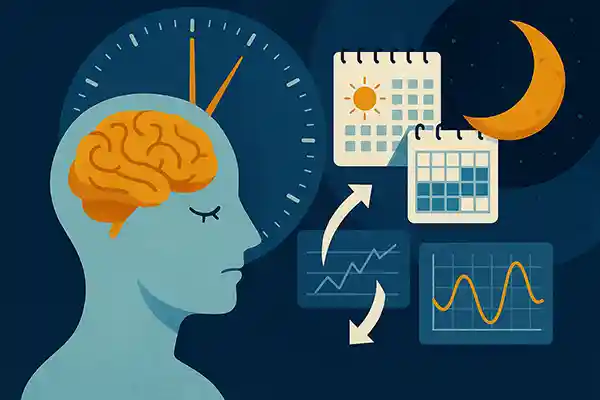
Image 3: When time shifts, the body resists – even a single lost hour can ripple through our hormones, hearts, and minds.
Click Here to Read What Is the Hiroshima Atomic Bombing’s Legacy – 80 Years Later…
What Is a Circadian Clock or Circadian Rhythm?
Our circadian clock is an internal 24-hour system synchronized by sunlight.
- Morning light suppresses melatonin and boosts cortisol for wakefulness
- Evening light delays sleep onset, pushing rest cycles later
DST throws this rhythm off-balance – the spring shift robs an hour of morning light, delaying sleep, while the autumn shift confuses the cycle further.
When our internal and social clocks diverge, sleep loss accumulates, increasing fatigue, irritability, and risk of chronic diseases.
Image 4: Our inner clock still answers to the sun, not society – proof that biology keeps its own time.
Click Here to Read What Is the Russian Volcano Eruption After 500 Years…
Road Safety: Are Crashes and Visibility Really Affected?
Yes – and significantly. The U.S. National Highway Traffic Safety Administration links spring’s forward shift to a 6% rise in fatal crashes, as drowsy drivers face darker mornings.
In the UK, the motoring group GEM Motoring Assist warns that up to 3,000 collisions yearly involve poor eyesight – and that risk climbs by 20% once evenings darken. Police forces in Sussex and Brighton now use the ‘extra hour’ after the autumn change to run eye-check campaigns, reminding drivers: vision matters more than precision.
Meanwhile, cyclists and pedestrians are urged to wear high-visibility clothing and check their lights – small steps that can literally save lives in the shadow of shorter days.
Brighter evenings may feel safer, but in reality, both transitions demand heightened caution on the road.

Image 5: An hour’s sleep can separate safety from risk – darker commutes and slower reflexes make timing a matter of life and light.
Click Here to Read What Is Coral Bleaching…
Energy, Economy, and Daily Life: Does DST Still ‘Save’?
Originally, DST was about energy efficiency. When it began, homes relied on daylight to save candles and coal. Today’s 24-hour society has flipped the equation. Air-conditioning, lighting, and screen time consume energy regardless of sunset.
Economists at the London School of Economics now estimate that the twice-yearly switch costs over €750 ($880) per person annually in lost productivity and healthcare impacts. On the flip side, businesses like retail and tourism benefit from brighter evenings. The U.S. Chamber of Commerce once quipped that daylight saving adds ‘an extra hour of shopping’.
But for shift workers, medical staff, and those already sleep-deprived, DST often means living life out of sync. Scientists argue permanent standard time – aligned with solar patterns – would better support public health than endless light chasing.
The bottom line: DST saves daylight – not energy.
Click Here to Read What Is Botox…
What Is Permanent Standard Time?
Permanent Standard Time means keeping clocks aligned with natural sunlight all year. Sleep experts favor it because morning light stabilizes our circadian rhythm and mental health.
In contrast, Permanent Daylight Saving Time would make winter mornings darker, delaying sunrise to nearly 9 a.m. in some regions – leaving schoolchildren and workers commuting in darkness.
In short: Permanent Standard Time favors biology. Permanent DST favors business.
Click Here to Read What Is Giorgio Armani’s Legacy…
Policy Gridlock: Why Does the U.S. Keep Stalling – and What About Europe?
In 2022, the U.S. Senate unanimously passed the Sunshine Protection Act to make DST permanent. But by 2025, the effort has stalled again. Lawmakers remain split:
- Supporters say it boosts evening economy and safety
- Critics argue it forces children to commute in darkness
Senator Tom Cotton warned it would ‘repeat a 1974 mistake’, when permanent DST left entire states in pre-dawn gloom.
Europe faces a similar divide. The European Parliament’s 2019 vote to abolish seasonal clock changes hasn’t been implemented – countries disagree on which time to keep.
The irony: almost everyone wants to ‘lock the clock’, but no one agrees where to lock it.
Click Here to Read What Is Tesla’s New ‘Affordable’ Model 3 & Model Y…
Coping with Long Winter Nights: Practical Routines That Work
When nights lengthen, mental health often dips. Up to 1 million people in the UK experience symptoms of Seasonal Affective Disorder (SAD) each winter.
Psychologists suggest embracing light – both natural and artificial. The ‘Wintering Well’ project in Scotland distributes therapeutic lamps and guides people to build ‘light routines’ – morning exposure, mid-day walks, and cosy interior setups inspired by Scandinavian hygge culture.
Experts advise:
- Spend at least 30 minutes outdoors daily
- Use warm, layered indoor lighting instead of harsh overheads
- Keep consistent sleep schedules, even on darker days
- Redesign interior spaces with reflective surfaces and warm tones
In essence, reclaim the light – don’t wait for spring to restore it.
Click Here to Read What Is a Blizzard…
What Is Seasonal Affective Disorder?
Seasonal Affective Disorder (SAD) is a type of depression triggered by shorter daylight hours. Common in northern latitudes, it affects energy levels, appetite, and sleep.
First identified by psychiatrist Norman Rosenthal in the 1980s, SAD is now treated with light therapy, CBT, and routine-based interventions.
In the UK alone, over one million people experience SAD symptoms each year – proof that our mental health literally follows the sun.
Click Here to Read What Is ‘The Life of a Showgirl’…
Heritage Timekeepers: Who Still Turns the Great Clocks?
While most of us rely on smartphones, Britain’s old tower clocks still change by hand. Volunteers climb church steeples, train stations, and museums to reset gears built centuries ago.
At St Catherine’s Church in Somerset, wardens pause a 15th-century mechanism for an hour to ‘let time catch up’. In Bristol’s Temple Meads Station, an engineer travels city to city, winding and resetting monumental clock faces by midnight.
These keepers of time embody a rare link between human craft and celestial rhythm – a reminder that even in a digital age, some things still tick by touch, not code.
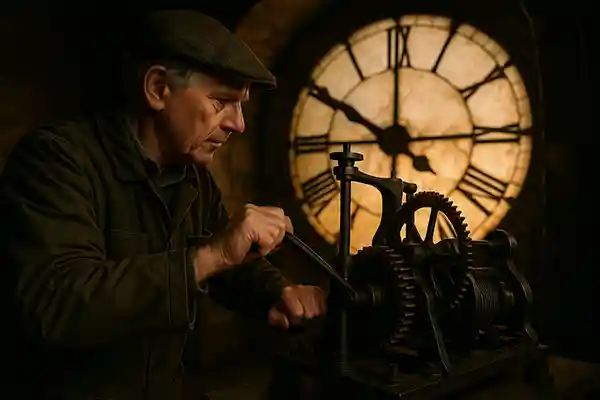
Image 6: As machines automate time, a few human hands still keep history ticking – one turn at a time.
Click Here to Read What Is a Government Shutdown…
WGF Take – Aren’t Natural Clocks Better than Human-Made Clocks?
Locking the clock may feel like progress, but the right time to lock is standard time, not permanent daylight saving. Human biology thrives on morning light, not extended evenings. Darkness in the school run and fatigue at dawn can’t be legislated away.
Human-made clocks track seconds; biological clocks measure life. For over a century, governments have chased sunlight by law – only to find that the body resists.
Daylight Saving Time once saved energy. Now it costs health, sleep, and clarity. The evidence tilts toward Permanent Standard Time, where sunrise and sanity align.
Until policy catches up with physiology, we can at least honor the rhythm that nature set: sleep when it’s dark, rise when it’s light, and let time serve life – not rule it.
As nations debate, citizens can adapt – with healthier sleep patterns, light-conscious routines, and renewed awareness of how the body keeps time.
Because in the end, the clock on the wall is negotiable – the one inside us isn’t.
Follow World Growth Forums on the following for more updates…