
Science & Technology

World Growth Forums Magazine

Keynote Speech by Dr Alfredo Sfeir-Younis _ WGF-GBIF Thailand 2024
What Is ChatGPT Atlas?
Will OpenAI’s New Browser Challenge Google Chrome?
On October 21, 2025, OpenAI, the company behind ChatGPT, unveiled a new AI-powered web browser called ChatGPT Atlas, aiming to redefine how people explore the Internet. Unlike traditional browsers, Atlas has no address bar. Instead, users simply ask ChatGPT what they want, and the AI handles the rest – from finding information to completing tasks. The launch, currently exclusive to Apple’s macOS, signals OpenAI’s most direct challenge yet to Google Chrome, which still dominates the global browser market.
The debut of Atlas could reshape not only how users search but also how the web itself is monetized.
With this launch, OpenAI has stepped directly into Google’s territory, challenging Chrome’s 71.9% global market share and proposing a future where AI doesn’t just assist your search – it is your search.
Image 1: OpenAI’s new browser marks a turning point – where searching the web evolves into conversing with it.
Click Here to Read WGF Blogs from World Leaders…
What Is the Story of ChatGPT Atlas?
The story of Atlas begins not with technology, but with timing. OpenAI’s ChatGPT has already transformed how people learn, write, and plan. Now, with more than 800 million weekly active users, the company seeks to extend that influence into everyday browsing.
Atlas represents the next logical step: a browser that doesn’t wait for you to click – it acts on your intent.
In demonstrations, ChatGPT Atlas could summarize news articles, compare hotel prices, and even book groceries autonomously through its Agent Mode.
For OpenAI, this isn’t just another product launch; it’s the start of an AI-led reshaping of the web itself.

Image 2: ChatGPT Atlas reimagines how people explore the Internet – shifting from typing queries to expressing intent.
Click Here to Read What Is Behind Nvidia’s $5 Billion Lifeline to Intel…
Did You Know?
ChatGPT Atlas
- The browser has no address bar, making conversation the new navigation
- It currently supports macOS, with Windows, iOS, and Android versions in development
- Atlas’s Agent Mode is available only to paid ChatGPT subscribers for now
Did You Know?
Google Chrome
- Chrome was launched on September 2, 2008, and quickly became the world’s most-used browser
- It controls over 70% of the global browser market
- Despite being declared an illegal monopolist in online search last year, Google retained control of Chrome after a U.S. court decision
Click Here to Read What Is NATO…
ChatGPT Atlas In Numbers
• 800 million: Weekly active ChatGPT users (as of October 2025)
• 1,000%: Search interest spike for ‘ChatGPT Atlas’ within 24 hours of launch
• 71.9%: Global browser market share held by Google Chrome
• 5.99%: Desktop searches already handled by AI models like ChatGPT (as of July 2025)
• $0: Current ad revenue for OpenAI (but analysts expect this to change soon)
Click Here to Watch Keynote Speeches and Interviews of World Leaders at WGF YouTube…
Historical Note
When the first web browsers appeared in the 1990s – like Mosaic and Netscape Navigator – they turned the Internet into a visual, accessible world.
In 2008, Google Chrome redefined browsing through speed, simplicity, and tabs.
Today, in 2025, OpenAI’s ChatGPT Atlas might do for intelligence what Chrome did for speed.
Atlas doesn’t just load pages – it interprets them. In the same way the compass guided sailors centuries ago, Atlas could become the navigator of the new digital age, mapping not oceans, but human–machine understanding.
Click Here to Read What Is the Trump–Putin Alaska Summit About…
What Is the Story of OpenAI?
Founded in 2015 by Sam Altman, Elon Musk, Greg Brockman, and others, OpenAI began as a non-profit research lab aiming to ensure that artificial general intelligence (AGI) benefits all of humanity.
The company transitioned into a capped-profit model in 2019 and later partnered with Microsoft, which invested billions to support its large-scale AI computing infrastructure.
OpenAI’s releases – GPT-5, ChatGPT, DALL·E 3, and Sora – revolutionized how people interact with AI, sparking both mass adoption and deep ethical questions about creativity, privacy, and control.
Click Here to Watch WGF News on World Leaders at WGF TV…
So, What Is ChatGPT Atlas?
ChatGPT Atlas is an AI-native browser that replaces the old address bar with a chat window powered by ChatGPT. You no longer type ‘www’ or URLs – you talk to the browser.
Atlas can:
- Summarize or compare content from multiple websites
- Fill out forms, draft emails, or generate code snippets
- In ‘Agent Mode’, even browse and act independently – like researching a topic, finding a recipe, and ordering ingredients online
In essence, Atlas is not a tool you use – it’s a partner that acts on your behalf.
Click Here to Read What Is A Ceasefire Agreement…
What Is an AI-native Browser?
An AI-native browser is designed from the ground up to use artificial intelligence as its core engine, not an add-on. Traditional browsers like Chrome, Edge, or Safari depend on keyword-based search and manual navigation.
AI-native browsers, however:
- Understand intent rather than syntax
- Learn from user behavior across sessions
- Blend search, reasoning, and automation seamlessly
Atlas is among the first large-scale attempts at making this vision mainstream.
Click Here to Read What Is De-Dollarisation…
What Is Agent Mode?
Agent Mode is Atlas’s premium, autonomous browsing feature. It allows ChatGPT to perform multi-step actions – from analyzing data to completing online purchases – without constant user input.
In OpenAI’s demonstration, the browser:
- Found a recipe online
- Located ingredients on Instacart, and
- Added them to the shopping cart automatically
This shift from manual search to AI delegation could redefine how people interact with the Internet.

Image 3: Agent Mode transforms ChatGPT from a guide into a doer – autonomously completing online actions for users.
Click Here to Read What Is the Hiroshima Atomic Bombing’s Legacy – 80 Years Later…
Why Did OpenAI Build a Browser?
OpenAI’s vision is both technological and strategic. By building Atlas, the company:
- Expands ChatGPT beyond chat into real-world digital utility
- Reduces dependence on other ecosystems like Microsoft or Google
- Gathers context-rich data to improve AI reasoning
- Tests monetization models, from subscriptions to eventual ad integrations
It’s also a defensive move. As Google integrates its Gemini AI into Chrome, OpenAI wants to ensure that ChatGPT stays the starting point of every search.
Click Here to Read What Is the Russian Volcano Eruption After 500 Years…
How Does Atlas Compete with Google and Microsoft?
Google Chrome offers AI summaries, while Microsoft Edge integrates Copilot – but both still revolve around URLs and keywords.
Atlas in contrast:
- Hides the address bar by design and emphasizes natural-language interaction
- Treats the user’s intent as the query
- Delivers a chat-first browsing experience
Experts predict that while tech enthusiasts will adopt Atlas quickly, enterprises might wait – given privacy and integration concerns. Still, the conceptual leap is undeniable: Atlas transforms browsers from gateways into thinking assistants.
Click Here to Read What Is Coral Bleaching…
What Is AI-first Browsing?
AI-first browsing means letting artificial intelligence drive discovery. Instead of typing and navigating manually, users express goals, and the browser reasons out solutions.
This model:
- Compresses the search-to-action journey
- Offers personalized summaries instead of link lists
- Bridges text, vision, and data in one space
In short, AI-first browsing means you describe the destination; the browser figures out the route.
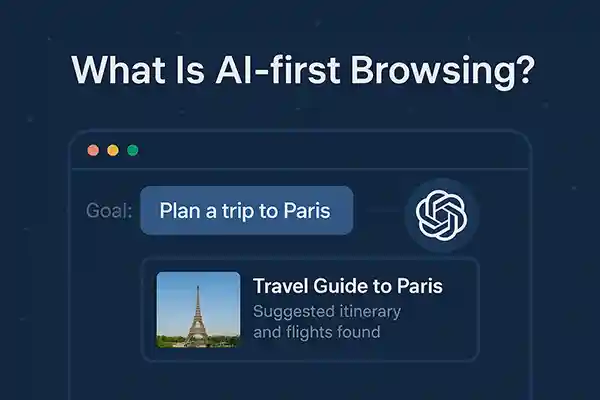
Image 4: AI-first browsing begins with goals, not keywords – turning every search into a personalized, context-driven journey.
Click Here to Read What Is Botox…
What Does This Mean for the Future of Search and Ads?
The rise of AI browsers could reshape digital advertising. Google’s dominance is built on search ads – each keyword worth billions in revenue. But when users no longer type keywords, what happens to ad placement?
Analysts predict that OpenAI may soon introduce conversational sponsorships or contextual AI recommendations, creating a new kind of ad economy where the dialogue itself becomes the marketplace.
Click Here to Read What Is Giorgio Armani’s Legacy…
What Is a Search Paradigm Shift?
A search paradigm shift means a fundamental change in how people retrieve information. For years, search was reactive – you typed, and the system fetched. Now, it’s becoming proactive – you express intent, and AI anticipates needs.
This shift mirrors the evolution from:
- Books to Google
- Google to ChatGPT
- ChatGPT to Atlas, where browsing becomes a continuous learning conversation
Click Here to Read What Is Tesla’s New ‘Affordable’ Model 3 & Model Y…
WGF Take – At Last, an Atlas of Human–Machine Intelligence?
Atlas is not just a new product – it’s a philosophical shift. It challenges the decades-old notion that humans browse and machines fetch. With Atlas, the machine understands context, intent, and outcome, offering not just results but resolution.
Whether users embrace it widely or cautiously, one thing is clear: The age of passive search is ending, and the age of active AI navigation has begun. In trying to out-Google Google, OpenAI is charting a new atlas – not of geography, but of digital intelligence.
On the other hand, Atlas isn’t merely a competitor – it’s a conceptual compass for where AI and the Internet are heading. It suggests a world where your browser doesn’t wait for clicks – it thinks, reasons, and assists.
Google taught us to search. OpenAI now wants to teach us to ask. If Chrome was the gateway to the world’s information, Atlas might become the gateway to the world’s intelligence.
At last, the map of the digital world isn’t drawn by humans alone – it’s being co-authored by machines.

Image 5: Atlas symbolizes the dawn of collaboration – where human curiosity meets machine intelligence to co-create the map of tomorrow’s Internet.
Follow World Growth Forums on the following for more updates…